
Our team has been working in real estate for a long time. Collectively we’re looking at over 40 years of experience and each of us has been doing it for more than 10 years. Experience brings lots of benefits, but in real estate, we’d argue the biggest benefit is that we’ve helped clients in different types of markets.
Helping a client buy or sell in a hot seller’s market is very different than helping someone in a tight buyer’s market, as is what’s required to get deals done in a more balanced market.
We are absolutely in a buyer’s market in Toronto and all parts of the GTA right now (October 2026) and that means that lots of sellers are experiencing challenges getting their homes sold at the best price. When that happens, there is a tendency to wait and hope the right buyer will show up.
There are a significant number of listings on the market right now that have been for sale for months or even over a year. A number of them contain outdated information, like an occupancy date from two months ago, or a reference to a season that is now well over.
In our work with sellers, we focus strongly on an accurate current valuation and talk about the danger of waiting for the right buyer. Below are the three aspects of waiting that can make it a very dangerous approach. No more waiting around, let’s get to it!
The future’s so bright I gotta wear shades.
Back in 1986, there was a band called Timbuk 3 who had a hit song called “The Future’s So Bright, I Gotta Wear Shades”. Despite the positive title, it didn’t prove true for the band, as this was their one and only hit.
In real estate, the biggest reason that sellers hold off on lowering their price or taking a lower than desired offer is because they hope things will get better.
Not seeing many showings or reasonable offers on your place? Give it time and wait for someone to appear who sees the value in the home.
In principle, this isn’t a terrible idea. Some markets are stagnant, with not much happening to prices and they just move slowly, so it takes time to sell. Other markets are improving and what may not be an appealing price to buyers today could look like a bargain in a month. In either of those markets, patience wins the day.
There are also markets where prices are dropping over time. While Toronto and our surrounding municipalities had an extended period where that wasn’t the case, the market data since 2022 show a different story.
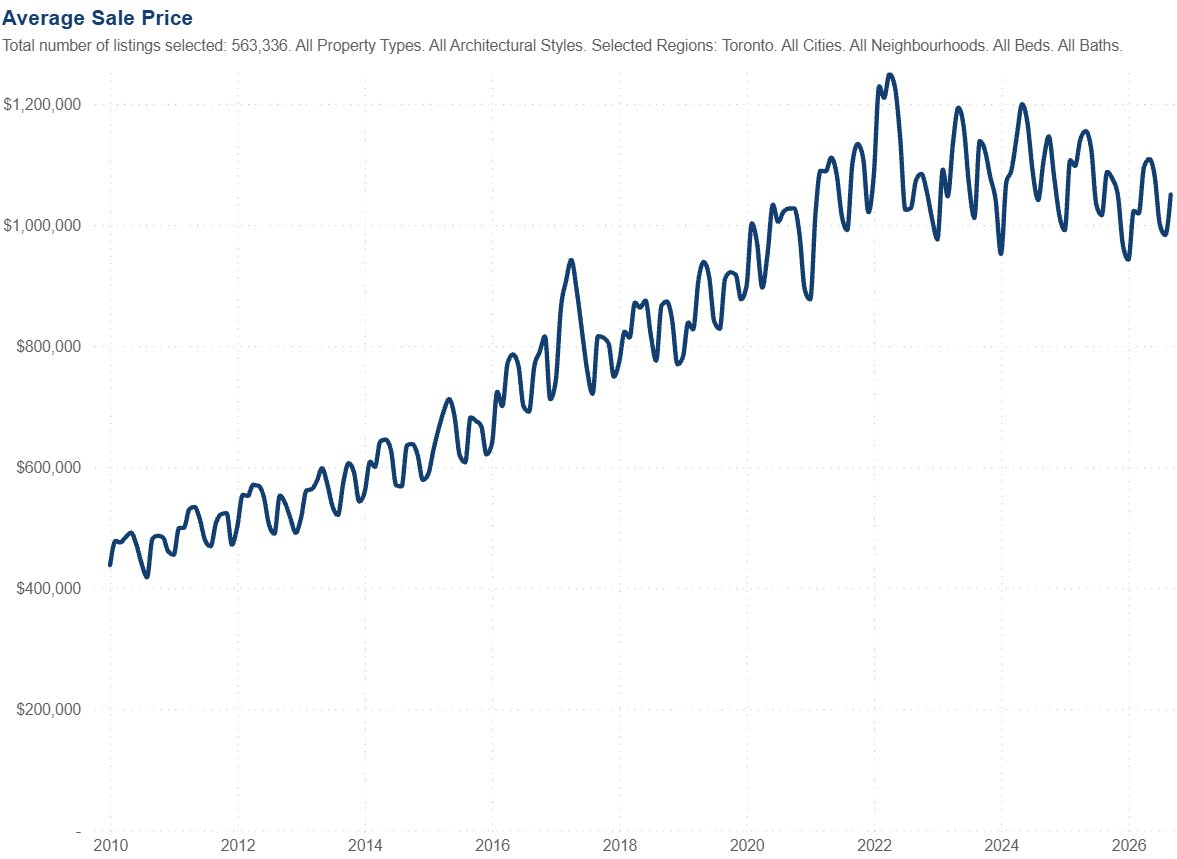
The chart below shows the average sale price in Toronto going back to 2010. It’s per month, so you see a fair bit of variation, but up until 2022, there was no question about which direction the market was heading.
It’s even clearer when we look at the average annual price. We saw a flat period during 2017 and early 2018, but by late 2018, buyers were once again pushing prices up. This time period was when we had a number of government initiatives, including the April 2017 Fair Housing Plan, that caused a number of buyers to postpone their purchases. January 2018 saw the introduction of the mortgage stress test and that further slowed things down. By the fall of 2018, however, we had less than two months of inventory in Toronto and prices started moving up again.
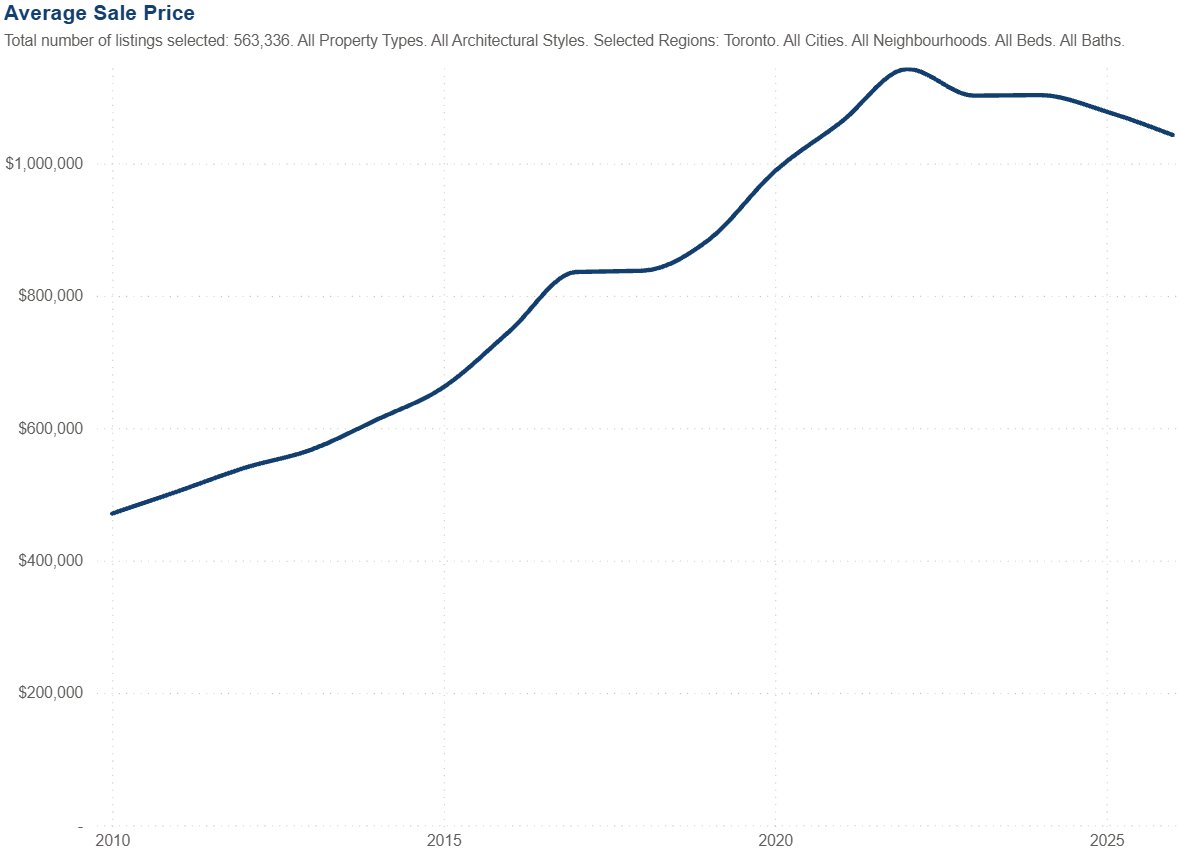
The roller coaster continued heading up until 2022 and since then we’ve seen drops, flat markets and more drops.
Any seller who was listed for sale in April 2022 had good reason to think that waiting was a valid strategy. After all, the average price for a home in Toronto had gone up almost 15% compared to a year earlier. If you weren’t getting bites at the price you wanted, hold off and you soon would have someone eager to pay that price or more.
Then it happened. In May 2022, average prices dropped 1.6% compared to April, then in June, another 6.9% drop compared to May, then another 10.5% month over month drop in July. We saw some rebounds but by the time April 2023 rolled around, the average price in the city was down 9% compared to a year earlier.
A seller who had waited for the market to give them the price they wanted would have likely found that not only was their price not attractive, but it had also become wildly overpriced. By April 2024, the average price had gone back up 1% from April 2023, but remember that means you’re still down 8% compared to the height. A year after that in April 2025, the average price had dropped down half a percent, so now that seller was down 8.5% from their April 2022 height. In April of 2026, we’d dropped another 4% compared to April 2025, bringing the total drop in Toronto to 12.5% since our height.
These are average prices, not individual homes, and the market is very much dependent on the location, housing type and price point, but we think the lesson is clear.
If you wait for the “right” buyer who appreciates your home at the price you want – when the market is saying it is too high – you may be waiting a very long time. In essence, you’re betting on the market improving. If it stays flat, you are overpriced. If it drops, you’re very overpriced.
While that is a sobering assessment, it gets even worse when you consider what it costs to own the property as time passes.
Carry this for me, will you?
Regardless of how much a home is worth at a given point in time, the costs for carrying the home tend to increase over time.
We did see a brief period of deflation in Canada at the start of COVID, with two month over month decreases in April and May of 2020, driven by collapsing gas prices and reduced consumer demand. The last time that we saw an annual period of deflation, however, was back in 1953.
Prices rise, things get more expensive and whatever you’re paying for utilities, property tax and home maintenance is likely more this year than it was a year ago.
The cost of financing a home can also rise and dramatically impact the carrying cost for any given property. As you can see from the chart below, whether it was fixed or variable, rates have increased significantly since 2021.
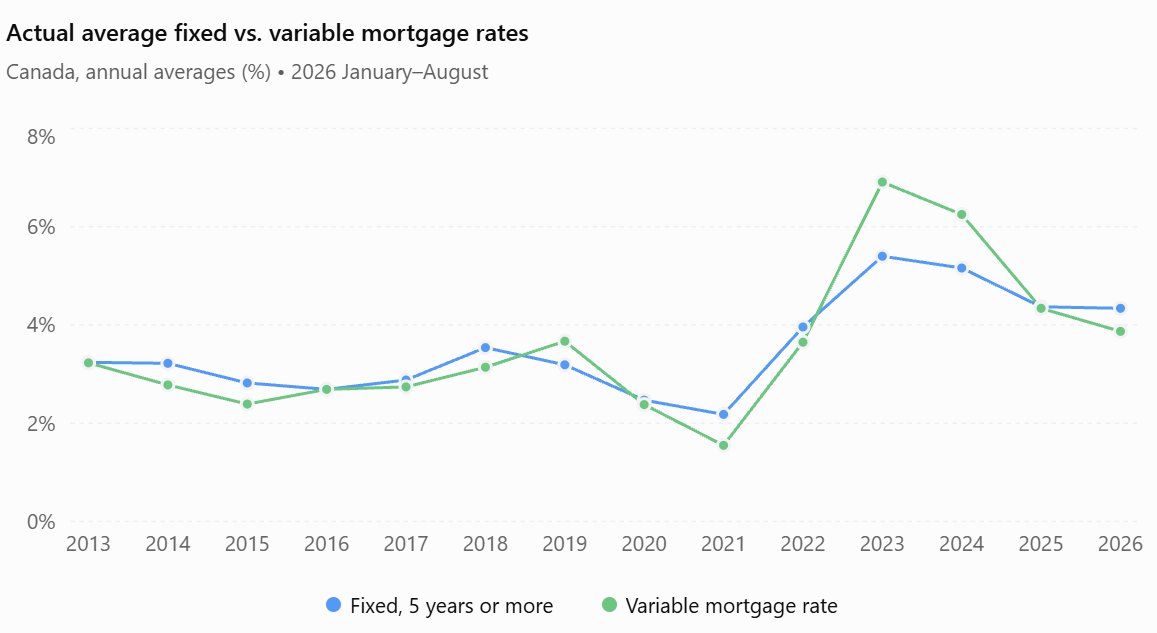
While individuals qualify for (and chose) different types of mortgages, it is clear that the cost of carrying a mortgage increased for many home owners during the period of 2021 to 2026. This naturally has a significant impact on real estate prices. Some home owners sell because they can no longer afford to keep the home and others see their principal repayment dwindle and fail to build up enough equity to move up the property ladder.
The final unintended consequence of waiting for the right buyer is less about logic, and more about emotions.
Seems a little stale.
In real estate, we often talk about time being of the essence. Normally, we’re saying that in the context of seeing a home, submitting an offer, responding to offers and so forth.
It remains true in a broader sense as well, and the longer a home is on the market, the less likely it is to realize its highest, best price. Such “stale” listings often don’t do well with their eventual sale price.
The reason is simple. No one wants what no one wants.
Whether it is a restaurant with no customers, an amusement park ride with no line up or a house with no buyers, people look to other people to gauge value. The best home in the world can unfairly be stigmatized as having something wrong with it when it doesn’t sell.
A buyer who enters a home looking for problems will find problems. Any home that has been on the market for a longer time period than is typical in that neighbourhood or building will have buyers walking in prepared to validate the market reaction to date.
Even a buyer who likes the home shifts their stance when it comes to their offer strategy. Depending on the market, sale prices near list price on a property that has been on the market for an extended time are extremely rare. It is far more common to see low ball offers and attempts to capitalize on a perceived desperation on the seller’s behalf.
In a rising market, a home that has been on the market a while benefits from buyers worried that soon they won’t be able to afford anything. Such markets also tend to see sale prices over asking, so an overpriced home can sell at their list price in such a market.
If, however, we’re experiencing a stagnant or dropping market, there is nothing to stop a buyer from indulging in their bargain hunting tendencies.
Waiting for the right buyer can feel less risky than lowering your price or taking a price that isn’t what you hoped you’d receive. If the market is not rising, however, it can in fact be the worst decision. In a market where prices are staying the same, your carrying costs will rise and your property will become stale in the minds of buyers. If the market is actually dropping, you’ll face competition from similar or better homes priced for less than your property.
We work with our seller clients to get the best sale price for their home in the current market. That means we need to understand their market and develop the right strategy to sell it for the highest price. If that sounds appealing, get in touch with us to talk about next steps.
